Saturday, January 11, 2014
Piezo Powered Lamp Circuit Schematics
Energy is becoming ever more expensive, and some fresh ideas are needed. There are already human-powered devices on the market, most of which employ a dynamo to generate power. It is also possible to recover energy from a piezo crystal of the sort found, for example, in the loudspeakers in greetings cards. Making use of this device is relatively straightforward.
Piezo-Powered Lamp Circuit Diagram :

Piezo crystals can generate voltages of many tens of volts when given a firm enough prod with a finger to bend the baseplate. The charge moved, however, is relatively small and the crystal is effectively a capacitor with a capacitance of only around 20 nF to 50 nF. This means that we need larger-scale storage in the form of an electrolytic capacitor.
The piezo crystal can be treated as an alternating current source. We therefore need a rectifier and a reservoir capacitor. Pressing the metal surface of the transducer ten or twenty times with a finger will charge the electrolytic in steps to the point where it has enough charge to drive a LED. The circuit is a ‘charge pump’ in the full sense of the term.
When the button is pressed the electrolytic discharges into the LED, which emits a brief, but bright, flash of light.
Author : Burkhard Kainka - Copyright : Elektor

Friday, January 10, 2014
cell phone jammers for the star gazing has very high requirement
5 74HC148 to allow expansion of the end of Gs, respectively, received the sixth piece of 74HC148 low slices to a high order of the film I 0, I 1, I 2, the I 3 I 4 input, I 5, I 6 I 7 end is connected to high (no input), so the sixth three-chip 74HC148 output would mean that the 40-6 line priority encoder of three the A5. A4, A3. 40-6 line priority encoder low three output A2, A1, A0 5 74HC148 output terminal. 74HC148s output is not tri-state gate, can not be directly connected together. 5 74HC148 output of the same name received 74LS30 (8-input NAND gate) can be taken with non-solve this problem. The good service of cell phone jammers can be got with the lowest cost.
Terminal expansion, and 2051 less than the 89C51 P0 and P2, input / output port and an external ROM, the RAM in the pin 2051 is only 20 feet. AT89C2051 microcontroller is mainly applicable to relatively simple micro-control system. In this system, used in the AT89C2051 the six external I / O port, an external interrupts and serial output port. 12 Hangzhou University of Electronic Science and Technology graduate design 4-92051 signal pin Figure 4.5-level translation in the different digital systems, the level of the standard is different. The system includes a TTL level standard and RS-232 level standards, to achieve two standard normal communication, the need for level conversion. The harmonious production environment of cell phone jammers is necessary.cell phone jammers for the star gazing has very high requirement
Can guarantee the quality of training and reducing the consumption of ammunition is the ideal of public security, military and other departments trained to use the analog targeting system. The laser targeting system overview of the laser targeting system [1-3] works by using laser pulses to simulate the firing of bullets, the system generally includes a laser transmitter and laser signal detection module, shooting performance and display parts. Shown in Figure 2-1, when the shooter aimed at the completion of the pull the trigger, the semiconductor laser emits laser pulses fired at the target on the photodetector, if you hit the target, the laser pulse photodetector receiver and converted to electric signal processing circuit can identify the point of impact of the shooting, transfer to your computer encoded signal is processed.
10W Stereo Audio Amplifier Using TDA2009A
10W Stereo Audio Amplifier Circuit Diagram :

Thursday, January 9, 2014
Ac to DC Converter Circuit Diagram
Ac to DC Converter Circuit Diagram

The technology development of cell phone jammer has been finished
This mainly refers to the use of 25 ~ 100 W-class CO2 laser to X-Y table system-based laser processing machine models, but also the use of Nd YAG laser and galvanometer integrated machining. It can be carved, including engraving, cutting, engraving, embroidery and cutting. This has a variety of laser processing machine, the price is low, wide use, the characteristics of suitable conditions, the annual output of 6,000 units, which can be used in seals, flexible plates, gifts, advertising, printing cards, crafts and industrial non-metallic products, and on the horn, glass, plastic, rubber, wood products, plastics, fabrics, leather and other materials for laser processing. Because of this processing machine with computer typesetting, self-control, non-contact processing, fast (other than manual processing methods or faster), high intelligence, and other unique advantages of easy operation, it accounted for the majority of the domestic market and exported to Middle East, Southeast Asia, South America, Eastern Europe and Africa, popular with users. The technology development of cell phone jammer will enhance the quality of cell phone jammer .
Production of X-Y table models, high-profile companies in Zhejiang Boye Laser, Guangdong Yue Ming Wuhan Golden Laser Laser and other companies, the rapid rise of the formation of a laser processing machine of this type of production patterns. Currently Boye laser has been built 35000m2 plant, Golden Laser built a 10 000 m2 factory, Yueming laser not only further expand the production capacity of origin, established a branch in Shanghai. In addition to carving this type of flexible rubber, bamboo, it can also be laser-cut clothing, leather, embroidery and other processing products of these enterprises to upgrade and promote the market development. The technology development will improve the manufacturing quantity of cell phone jammer everyday.
These enterprises now will be feeding and rewinding, raw vacuum adsorption, automatic camera positioning, double cropping and other techniques to be applied gradually, the laser processing equipment can be integrated into automated garment production line operations, the product of intelligent upgrade. It is worth mentioning that the rapid development of laser engraving machine is one of the products, it is in the glass by laser-induced formation of burst point of the body composition of white three-dimensional laser light scattering images, this technology has recently made further development. Unit has developed a domestic color laser technology have played in the vitreous body red, orange, yellow, blue, purple and other color patterns, and soon the product will be put on the market, it will add luster to laser products. The technology improvement of cell phone jammer will increase the manufacturing ability of cell phone jammer .
Remanufacturing is the product life cycle theory as a guide for engineering practice. Equipment, feasibility studies, design, manufacture, use, maintenance and recovery of all costs are known as life-cycle cost, the traditional emphasis on the equipment, only the "first half", (this period only 20% to 40% of the cost), and often overlooked, "later life", that the use, maintenance and end of life costs.
Friday, December 27, 2013
Park Aid Modification Circuit
Park-Aid Modification Circuit Diagram

R15_____________3K3 1/4W Resistor
R16___________330K 1/4W Resistor
R17___________470K 1/4W Resistor
R18___________150K 1/4W Resistor
C6______________1µF 63V Electrolytic or Polyester Capacitor
D8,D9,D10____1N4148 75V 150mA Diodes
IC4_____________555 Timer IC
BZ1___________Piezo sounder (incorporating 3KHz oscillator)
Wednesday, December 25, 2013
Simple Cmos Motorcycle Alarm Circuit Diagram
Cmos Motorcycle Alarm Schematic Diagram

Veroboard Layout

Tuesday, December 24, 2013
3 Channels Mini Mixer
Simple and cheap mixer circuit. This circuit supplied using 9V power supply. There is high/low-sensitivity switchable inputs for each input channel.
3 Channels Mini Mixer Circuit diagram :

Part List :
P1,P2,P3_________5K Linear Potentiometers
R1,R11,R15_____180K 1/4W Resistors
R2,R12,R16_______2M2 1/4W Resistors
R3,R13,R17_____750R 1/4W Resistors (See Notes)
R4,R14,R18_______1K 1/4W Resistors
R5______________15K 1/4W Resistor
R6_____________220R 1/4W Resistor
R7_______________1K5 1/4W Resistor
R8_____________820R 1/4W Resistor
R9_____________150R 1/4W Resistor
R10____________100K 1/4W Resistor
C1,C6,C8_________1µF 63V Polyester or Electrolytic Capacitors
C2,C4,C7,C9____100µF 25V Electrolytic Capacitors
C3,C5__________220µF 25V Electrolytic Capacitors
Q1,Q4,Q5______BC550C 45V 100mA Low noise High gain NPN Transistors
Q2____________BC547 45V 100mA General purpose NPN Transistor
Q3____________BC557 45V 100mA General purpose PNP Transistor
J1,J2,J3________3mm or 6mm Mono Jack sockets
SW1,2,3,4______SPST Toggle or Slider Switches
B1_______________9V PP3 Battery
Clip for PP3 Battery
Sunday, December 22, 2013
Simple Positive Regulator Circuit Diagram

Saturday, December 21, 2013
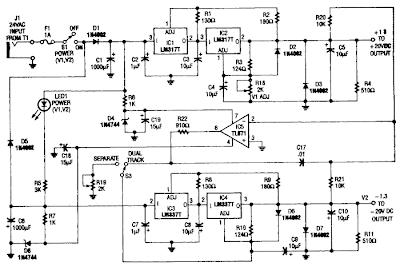
Tracking Dual Output Bipolar Supply Circuit Diagram
Thursday, December 19, 2013
Simple Photomultiplier Supply Circuit Diagram

Wednesday, December 18, 2013
The warehouse needs more room to accommodate more Cell Phone Jammers
Intelligently find nearby gas stations, restaurants, supermarkets and parking lots. In the long-distance travel in the car, no longer have to ask how to get high-speed ahead, out of which the intersection, as long as the marked destination, set the priority to high-speed road, will help you plan out where you want to go the best route. Such as Xinjiang from Beijing to self-driving tour, you can enter Urumqi. The warehouse of Cell Phone Jammers is near the subfactory.
When you deviate from the route has been selected, will prompt you off course, and it will automatically re-plan your route. The current map, there are more than 400 cities in the country a detailed map, a small county-level cities have, as well as the countrys highway network detailed map, as well as tourist zones, mountain maps. Mainly in travel, hiking, picnic, etc., when used to plan routes, indicating position, record tourist track. You can climb a Piedmont, mountain climbing using the previous track. GPS devices have the track record of features, such as Guilin, or you want to self-driving tour of Tibet, you can download someone elses track, then do not ask for directions, directly under the flight path travel. The warehouse of Cell Phone Jammers will be closed at four o’clock.
IE browser produced by Microsoft, a browser, and using free (and Win) bundled manner to the user, that is, as long as you use the Win family of operating systems would certainly have the IE browser, but also because So, IE has occupied the vast majority of personal computer browser share, other non-IE (core) browser such as Netscape NETSCAPE, OPERA and FIREFOX also individual users in general are rare. Is a low-power short-range wireless connectivity technology standard in lieu of that, "Bluetooth" is taken from a unified in the 10th century Danish king, Harald II, (Harald) of the nickname, the "Bluetooth" (Bluetooth). "Bluetooth" technology is the first five world-renowned advocate of computer and communications companies: Ericsson, Ericsson, International Business Machines IBM, Intel, Intel, Nokia Nokia, and Toshiba Toshiba. And in May 1998 set up a "Bluetooth" special interest group (Bluetooth Special Interest Group-SIG), the organization adopted a free transfer to industry of the patented technology strategy to achieve its goal of global harmonization of standards. The worker needs to get the needed Cell Phone Jammers before it is closed.
The goal is to achieve maximum data transfer speed 1Mbps (the effective transmission speed of 721kbps), the maximum transmission distance of 10 meters, the user can not have been allowed to use the 2.4GHz ISM (industrial, scientific, medical) band, set up in its 79 channel bandwidth of 1MHz, with a frequency of 1,600 times per second switching, hobbing (hobbing) mode technology to achieve spread spectrum radio transceiver. This is the origin and characteristics of Bluetooth technology. Bluetooth technology to communicate with the equipment, determine the frequency roll into gear mode "caller" and its communication opponent, "by taking sides." Caller before they take the same time by the parties and seven communication. Therefore, the caller can be taken together with the seven parties were famous for the 8 devices to connect Piconet (sawtooth network) subnet. Piconet taken by the parties within the same time as the subject to take more than two parties Piconet. In July 1999, announced the official Bluetooth specification BluetoothVersion 1.0. Comply with the specifications of cell phones and laptop computers will be listed in late 1999 or early 2000. Bluetooth technology products make claims that the companies are growing, the current Bluetooth standards bodies "BluetoothSIG (Special Interest mix)" members of the enterprises has increased to 800 or more.
Monday, December 16, 2013
Simple Positive And Negative Voltage Power Supply Circuit Diagram

Source Simple Positive And Negative Voltage Power Supply Circuit Diagram
Wednesday, October 9, 2013
Auto Power Off
 The switch is formed by a p-n-p darlington, T1, which is actuated by push-button switch S1. The very high amplification of the darlington enables it to be kept on fairly long with the aid of a relatively small-value capacitor, C1 (= 100 µF). Resistor R3 limits the charging current of C1 to ensure a long life of S1. Resistors R1 and R2, in conjunction with C1, determine the switch-on time. When this time has elapsed, R1 ensures that T1 is switched off. Since the darlington can handle a UBE of –10 V, a polarity protection diode is not needed.
Tuesday, October 8, 2013
1994 Chevrolet S10 Blazer Wiring Diagram
 |
| 1994 Chevrolet S10 Blazer |
Sunday, October 6, 2013
Battery Discharger Using Discrete Components
The battery discharger published in this website may be improved by adding a Schottky diode (D3). This ensures that a NiCd cell is discharged not to 0.6–0.7 V, but to just under 1 V as recommended by the manufacturers. An additional effect is then that light-emitting diode D2 flashes when the battery connected to the terminals is flat. The circuit in the diagram is based on an astable multivibrator operating at a frequency of about 25 kHz. When transistor T2 conducts, a current flows through inductor L1, whereupon energy is stored in the resulting electromagnetic field. When T2 is cut off, the field collapses, whereupon a counter-emf is produced at a level that exceeds the forward voltage (about 1.6 V) of D2.

A current then flows through the diode so that this lights. Diode D1 prevents the current flowing through R4 and C2. This process is halted only when the battery voltage no longer provides a sufficient base potential for the transistors. In the original circuit, this happened at about 0.65 V. The addition of the forward bias of D3 (about 0.3 V), the final discharge voltage of the battery is raised to 0.9–1.0 V. Additional resistors R5 and R6 ensure that sufficient current flows through D3. When the battery is discharged to the recommended level, it must be removed from the discharger since, in contrast to the original circuit, a small current continues to flow through D3, R2-R3, and R5-R6 until the battery is totally discharged.
The flashing of D2 when the battery is nearing recommended discharge is caused by the increasing internal resistance of the battery lowering the terminal voltage to below the threshold level. If no current flows, the internal resistance is of no consequence since the terminal voltage rises to the threshold voltage by taking some energy from the battery. When the discharge is complete to the recommended level, the LED goes out. It should therefore be noted that the battery is discharged sufficiently when the LED begins to flash.
Saturday, October 5, 2013
2001 Pontiac Grand Prix Wiring Diagram
 |
| 2001 Pontiac Grand Prix Wiring Diagram |
wire, blue wire, black wire, white black, camshaft position sensor, powertrain control module, knock sensor, camshaft position signal, engine speed signal, crankshaft position sensor, ignition control module, timing control, timing signal.
Thursday, October 3, 2013
Full duplex Intercom Circuit
No complex switching required, Simple circuitry, 6-12V supply
This design allows to operate two intercom stations leaving the operator free of using his/her hands in some other occupation, thus avoiding the usual "push-to-talk" operation mode. No complex changeover switching is required: the two units are connected together by means of a thin screened cable. As both microphones and loudspeakers are always in operation, a special circuit is used to avoid that the loudspeaker output can be picked-up by the microphone enclosed in the same box, causing a very undesirable and loud "howl", i.e. the well known "Larsen effect". A "Private" switch allows microphone muting, if required.
Circuit Diagram :
 Full-duplex Intercom Circuit diagram
Parts:
P1_____________22K Log. Potentiometer
R1_____________22K 1/4W Resistor
R2,R3_________100K 1/4W Resistors
R4_____________47K 1/4W Resistor
R5______________2K2 1/4W Resistor (See Notes)
R6______________6K8 1/4W Resistor
R7_____________22K 1/2W Carbon or Cermet Trimmer
R8______________2K7 1/4W Resistor
C1,C6_________100nF 63V Polyester or Ceramic Capacitors
C2,C3__________10µF 63V Electrolytic Capacitors
C4_____________22µF 25V Electrolytic Capacitor
C5_____________22nF 63V Polyester or Ceramic Capacitor
C7____________470µF 25V Electrolytic Capacitor
Q1____________BC547 45V 100mA NPN Transistor
IC1_________TDA7052 Audio power amplifier IC
SW1____________SPST miniature Switch
MIC____________Miniature electret microphone
SPKR___________8 Ohm Loudspeaker
Screened cable (See Text)
Circuit operation:
The circuit uses the TDA7052 audio power amplifier IC, capable of delivering about 1 Watt of output power at a supply voltage comprised in the 6 - 12V range. The unusual feature of this design is the microphone amplifier Q1: its 180° phase-shifted audio output taken at the Collector and its in-phase output taken at the Emitter are mixed by the C3, C4, R7 and R8 network and R7 is trimmed until the two incoming signals almost cancel out. In this way, the loudspeaker will reproduce a very faint copy of the signals picked-up by the microphone.
At the same time, as both Collectors of the two intercom units are tied together, the 180° phase-shifted signal will pass to the audio amplifier of the second unit without attenuation, so it will be loudly reproduced by its loudspeaker. The same operation will occur when speaking into the microphone of the second unit: if R7 will be correctly set, almost no output will be heard from its loudspeaker but a loud and clear reproduction will be heard at the first unit output.
Notes:
- The circuit is shown already doubled in the diagram. The two units can be built into two separate boxes and connected by a thin screened cable having the length desired.
- The cable screen is the negative ground path and the central wire is the signal path.
- The power supply can be a common wall-plug adapter having a voltage output in the 6 - 12V dc range @ about 200mA.
- Enclosing the power supply in the box of one unit, the other unit can be easily fed by using a two-wire screened cable, its second wire becoming the positive dc path.
- To avoid a two-wire screened cable, each unit may have its own separate power supply.
- Please note that R5 is the only part of the circuit that must not be doubled.
- Closing SW1 prevents signal transmission only, not reception.
- To setup the circuit, rotate the volume control (P1) of the first unit near its maximum and speak into the microphone. Adjust Trimmer R7 until your voice becomes almost inaudible when reproduced by the loudspeaker of the same unit.
- Do the same as above with the second unit.
Source : www.redcircuits.com
Wednesday, October 2, 2013
Video Out Coupling
If you want to connect a video signal to several destinations, you need a distribution amplifier to match the 75-ohm video cable. A distribution amplifier terminates the incoming cable in 75 ohms and provides several outputs, each with 75-ohm output impedance. Since this is usually achieved by putting a 75-ohm series resistor in the output lead of each video opamp (current-feedback amplifier), the opamps must be set up for a gain of 2 in order to achieve an insertion gain of 1 (0 dB). The disadvantage of this arrangement is that if the amplifier or its power supply fails, no signal is available at any of the outputs. This can be remedied by using a high input impedance amplifier, which can be tapped into a video line without having to have its own 75-ohm termination resistor.


In order to eliminate hum interference and voltage differences between the cable screen and the circuit earth, the circuit exploits the common-mode rejection of the opamp. This can be optimized with resistor RG1. With the indicated LT1396 video opamp, more than 40 dB of common-mode rejection can be achieved. The signal bandwidth of the circuit can be optimized using the trimpots. It reaches to more than 10 MHz, which is quite acceptable for video signals. Thanks to the high-impedance connection to the video line, the video signal is not affected when the power for the coupled amplifier is switched off. You can learn more about the LT1396 from its data sheet at http://www.linear-tech.com.
Monday, September 30, 2013
Programming The Propeller IC
Parallax, well known for its successful Basic Stamp IC, has recently introduced the Propeller: a new microcontroller with a certain difference. It packs no less than eight 32-bit processors (referred to as COGs in Propeller jargon) into a single package with only 40 pins. That design takes genuine simultaneous multiprocessing possible, and the sophisticated internal structure of the device makes it relatively easy to implement video and signal-processing applications. The Propeller can be programmed in assembly language or the high-level Spin language. The processor and the programming tools were developed entirely in-house by Parallax, with the hardware being designed from scratch starting at the transistor level.
Circuit diagram:

Programming The Propeller IC Circuit Diagram
The basic idea behind that was to avoid becoming involved in all sorts of patent disputes with other manufacturers. The result is astounding, and for software developers it certainly requires a change in mental gears. As is customary with modern microprocessors, the Propeller has a simple serial programming interface. The developer’s toolkit from Parallax has a modern USB port for that purpose, but a reasonably simple alternative (illustrated here) is also possible for anyone who prefers to work with the familiar RS232 port. Don’t forget that the Propeller works with a 3.3-V supply voltage.
Copyright: Elektor Electronics